
And Red Riding Hood spoke: "Nobody builds walls better than me, believe me. My friends say so, too. Giorgia, Jair, Elon, Kim, Benjamin, and Friedrich. But I am the leader. If they don’t want to be my friends anymore, I’ll throw sand. Then I’ve won. It’s my sandbox and I make all the rules. I also take people prisoner, hijack boats, and drop bombs wherever I want. And I’m not sharing my cake anymore. I am the best at everything I do. I will make our military so big, so powerful, and so strong that nobody will mess with us. I threaten everyone, and if they don't listen, I go to war—with whomever I choose. I can also get along with people; I’ve created a peace council. But Leo—Leo is terrible, just like all the other left-wing wackos. Hate Aid, NATO, Spain. Every year we give billions and billions of dollars to countries that don't even like us. That is going to stop. We’re gonna drill, baby, drill. We have more liquid gold under our feet than any other country. I won! Drill, baby, drill. Pew Pew!"
Such words from the land where Jazz was born. Today, the innovative power of this music is censored there; its development hindered and suppressed. Black culture is being massively marginalized by the current US regime. Even during Red Riding Hood’s first term, the country’s development was disastrous. Were current events part of a novel, it would face accusations of being surreal. Fairytales are unreal, but the accounts we receive from some artists in the USA do not tolerate such metaphors. The madness on the other side of the Atlantic has already caused too much suffering.
Beyond the mainstream desired by Red Riding Hood and his horde of uncultured primitives, there is so much fantastic new music from the pulse-setting avant-garde—from composers, improvisers, and virtuosos, all standing in the great tradition of Jazz with all its facets. We are absolutely thrilled ("happy as sandboys") to host several members of the Association for the Advancement of Creative Musicians (AACM) in Moers again this year. For years, our view of the USA was shaped by absorbing the music with wide eyes and open mouths, emulating it, and actually wanting to be just like it. Suddenly, we look across the Atlantic and realize that Red Riding Hood isn't a Little Red Riding Hood at all, but a greedy wolf who knows no consideration and no humanity. And who opens his maw and roars louder and louder: ME! ME! ME!
The moers festival looks forward to three magnificent drummers: Chris Corsano, Eliza Salem, and Ches Smith. To reeds and brass: Nicole Mitchell, Lakecia Benjamin, Nate Wooley, and Skylar Tang. To the top-tier contemporary ensemble YARN / WIRE. To Afro-Futurism with Black Earth Sway. To a reunion with Tomeka Reid. To an introduction to Tara Khozein, Joy Guidry, or the auditory magnifying glass in Morton Feldman’s space-time continuum. And to compositions by Jonah Haven and Nate Wooley. Peter Gelb, General Manager of the Metropolitan Opera in New York, warns: "Cultural creators in Europe today must understand that life as they know it, and as their audience knows it, is under threat."
"Moers is my festival. I made it huge. Nobody knows more about New Jazz than I do. I will lead you through five magnificent festival days, announce all my bands, and we will all have a fairytale time. Next year, a jazz center in the shape of an aircraft carrier will be built on Castle Square: the Melania Starship Freejazz Center. You’re going to love it. I understand more about architecture, acoustics, and charm than any other human being. The others know nothing. You know nothing either. And I am actually very humble. That is a great blessing."
The shooting of wolves is to be made easier again in the future under the Federal Hunting Protection Act.

Fairytales are passed down and transformed through generations. Oral traditions flow into a culture's collective memory or are transcribed in books. And sometimes, they simply gather dust there or fade away entirely—for not all fairytales find their way into books. Each year, through our ?Africa series, we focus on a specific country or region of the African continent. This year, we spotlight the Ewe people and their tradition of storytelling and folklore—a region known on today's world maps as Ghana, Togo, and Benin; a territory torn apart by colonial arbitrariness and shaped by German colonial history.
The Ewe tradition, now threatened with extinction, has transmitted its stories orally for centuries. Literary scholar Mensah Wekenon Tokponto describes how fairytales in the Ewe region are passed on through living practice: as darkness falls, people gather to tell, sing, and dance stories, weaving them into a rhythmic tapestry. Instead of remaining isolated, the community eats, drinks, and listens together. These tales convey messages and encourage values such as respect, honesty, and helpfulness.
Yet, this tradition is in danger of dying out, and with it the stories themselves—digital competition, led by the smartphone, is growing ever stronger. In response, Tokponto and his students have begun collecting these stories to preserve them in writing. In Moers, this tradition of communal listening and watching continues. Where the millions of voices of Ewe culture spin their threads, we encounter cunning spiders, wise elephants, and royal legends in ancient fables. They convey far more than mere morals—they are the beating heart of a living tradition.
We follow the trail of this unique narrative culture. Where stories do not live in books, but rather in the rhythm of drums and the breath of the storyteller, it quickly becomes clear: here, a fairytale is never "just" a fairytale. It serves simultaneously as an archive, a value system, and a compass for everyday life. The pranks of the spider Ananse or the origin myths of Notsie are not relics of the past. In the vibrant music of the Ewe, language, movement, and sound merge into a single entity.
In the Moers Soundwald, the deep roots of Vodun meet the free spirit of improvisation when the Anagoko Family from Benin joins rapper Sadky Goudou and Belgian musicians for the KOJO electro project. Under the direction of trumpeter Laurent Blondiau, a ritual cycle of breath and trance emerges—one that Blondiau has expanded for 2026 with electronic textures without losing its organic heartbeat. From Togo, Félicité Notson Kodjo-Atsou and Roger Atikpo bring their fairytales and narratives: while Félicité performatively uses the body as a vessel for memory, Atikpo lets the traditional Togolese kora speak. A powerful response to the question of heritage and future is provided by the collective Nana Benz du Togo. Inspired by legendary female icons of independence, they fuse West African tradition with modern club culture into a physically immersive ritual. Finally, father and daughter Osei Korankye from Accra use the traditional Seperewa to create soundscapes that bring the Ghanaian tradition of fairytale songs to life. In this year's ?Africa focus, we welcome around 20 participants across approximately 15 program events.
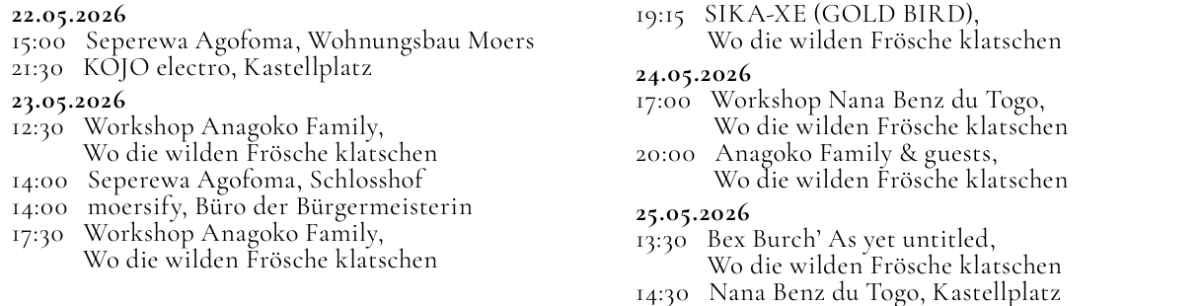
This program is made possible by the Kunststiftung NRW.